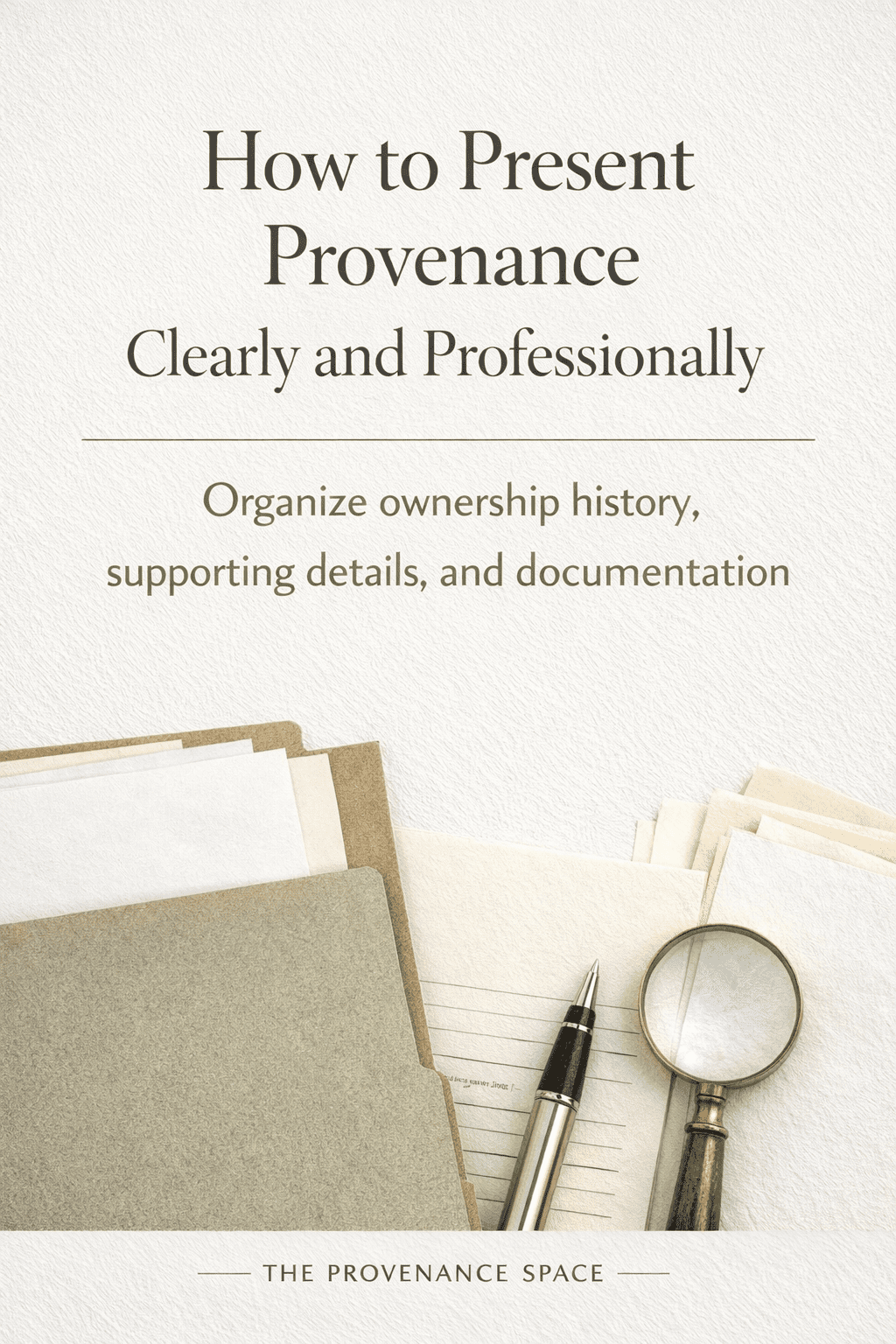
How to Present Provenance Clearly and Professionally
When selling a collectible, the object itself is only part of the story.
Just as important is how clearly its history is presented.
Provenance — the record of an item’s origin, ownership, and history — plays a major role in how buyers and auction houses assess credibility, risk, and value. Even strong items can be delayed or overlooked when provenance is unclear or poorly organized.
This guide explains how to present provenance clearly and professionally, and where structured tools like the Sell-Ready Documentation Kit can help simplify the process.
What Provenance Really Means (In Practice)
Provenance does not need to be perfect or exhaustive.
It needs to be clear, honest, and organized.
In practical terms, provenance usually includes:
- How the item was acquired
- Known ownership history
- Dates or periods of ownership
- Any supporting records or references
The Sell-Ready Documentation Kit is designed around these exact elements, helping sellers capture both complete and partial information in a structured, review-friendly format.
Why Presentation Matters More Than People Realize
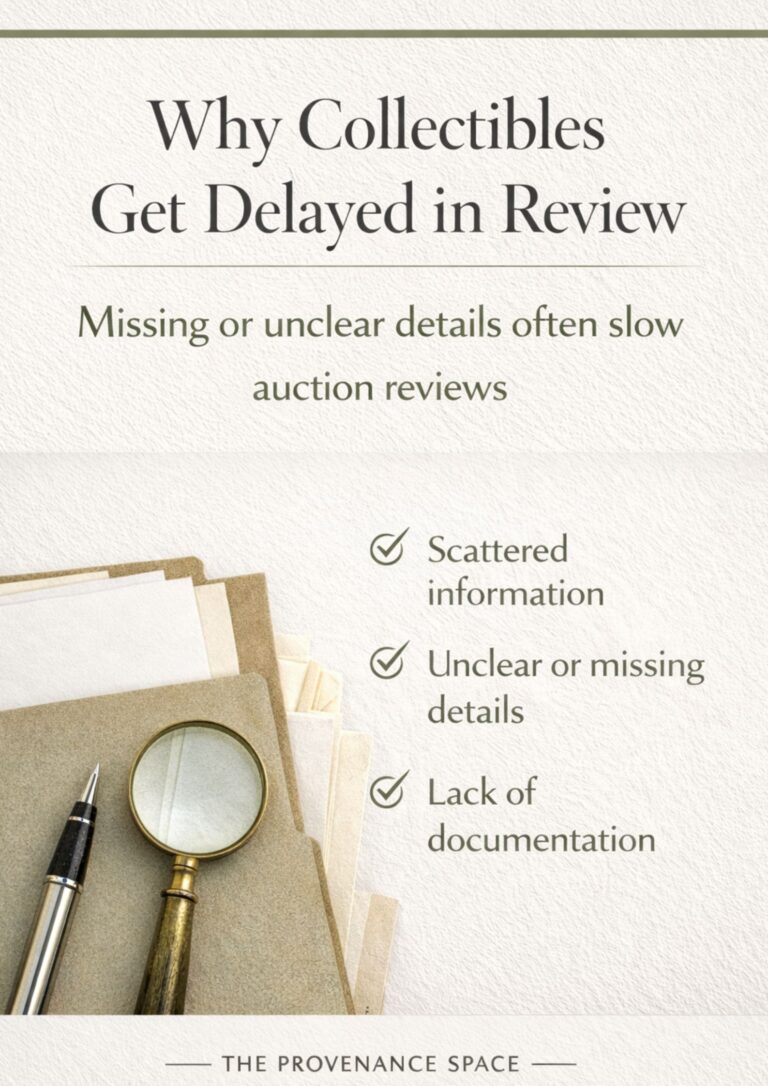
Auction houses and private buyers review many items, often remotely. When provenance is scattered across emails, verbal explanations, or informal notes, it creates uncertainty and slows decision-making.
Clear presentation helps reviewers:
- Understand the item faster
- Ask fewer follow-up questions
- Assess authenticity and risk more confidently
- Consider the item more efficiently for sale
This is why tools like the Sell-Ready Documentation Kit focus not just on what information is provided, but how it is presented.
Step 1: Start With a Clear Provenance Summary
Begin with a concise written summary of the item’s history.
A strong provenance summary typically includes:
- A brief description of the item
- How and when it entered the seller’s possession
- Any known prior ownership
- Relevant historical or contextual notes
The Sell-Ready Documentation Kit includes a dedicated Sell-Ready Provenance Summary template to guide this step, ensuring the information is clear, neutral, and easy to review.
Step 2: Separate Facts From Assumptions
Professional provenance presentation requires transparency.
Clear documentation distinguishes between:
- Confirmed facts
- Attributions or beliefs
- Unknown or missing information
For example:
- “Purchased from a private collector in Paris, circa 1998.”
- “Attributed to the mid-20th century based on materials and style.”
The Pre-Sale Authentication Checklist within the Sell-Ready Documentation Kit helps sellers make these distinctions clearly, reducing the risk of overstatement or confusion.
Step 3: Organize Ownership History Chronologically
If ownership history is available, present it in chronological order, even if it is incomplete.
This may include:
- Known owners
- Locations
- Approximate dates
The Ownership History Log in the Sell-Ready Documentation Kit provides a structured way to record this information, making gaps clear without weakening credibility. Missing details are common — transparency is what matters.
Step 4: Reference Supporting Materials Clearly
Supporting materials strengthen provenance when they are clearly listed and referenced.
These may include:
- Receipts or invoices
- Old labels or markings
- Exhibition references
- Photographs
- Letters or certificates
The Digital Documentation Index included in the Sell-Ready Documentation Kit helps sellers track and reference these materials clearly, so reviewers know exactly what exists and where to find it.
Step 5: Pair Provenance With a Condition Overview
Provenance works best when paired with a clear condition overview.
Condition information helps reviewers understand:
- How the item has aged
- Whether restorations affect historical integrity
- How condition aligns with provenance and use
The Condition Report Template in the Sell-Ready Documentation Kit provides a simple, structured way to document condition honestly, without requiring technical expertise.
Common Mistakes Sellers Make
Many sellers unintentionally weaken their provenance by:
- Mixing speculation with confirmed facts
- Sending information across multiple messages
- Relying on verbal explanations
- Waiting until after submission to organize documentation
The Sell-Ready Documentation Kit is designed to prevent these issues by encouraging sellers to prepare documentation before reaching out to buyers or auction houses.
Why a Structured Format Makes a Difference
Using a consistent structure helps ensure:
- Important details aren’t missed
- Documentation is easier to review
- Information can be reused for multiple submissions
- Sellers maintain control of how their item is presented
This is especially valuable for sellers considering both auction and private sale options. The Sell-Ready Documentation Kit was built with this flexibility in mind.
Preparing Sell-Ready Provenance With Confidence
Presenting provenance clearly doesn’t require legal expertise or institutional resources. It requires clarity, honesty, and organization.
The Sell-Ready Documentation Kit brings these elements together in one place, helping sellers move from uncertainty to preparedness — whether they are submitting to an auction house, speaking with a private buyer, or simply organizing their collection responsibly.
Final Thoughts
Clear provenance presentation doesn’t guarantee a sale, but it removes unnecessary barriers.
When provenance is documented and presented professionally:
- Reviews move faster
- Conversations are more productive
- Sellers are taken more seriously
If you’re preparing to sell, starting with structured documentation — such as the Sell-Ready Documentation Kit — puts you in a stronger position from the outset.