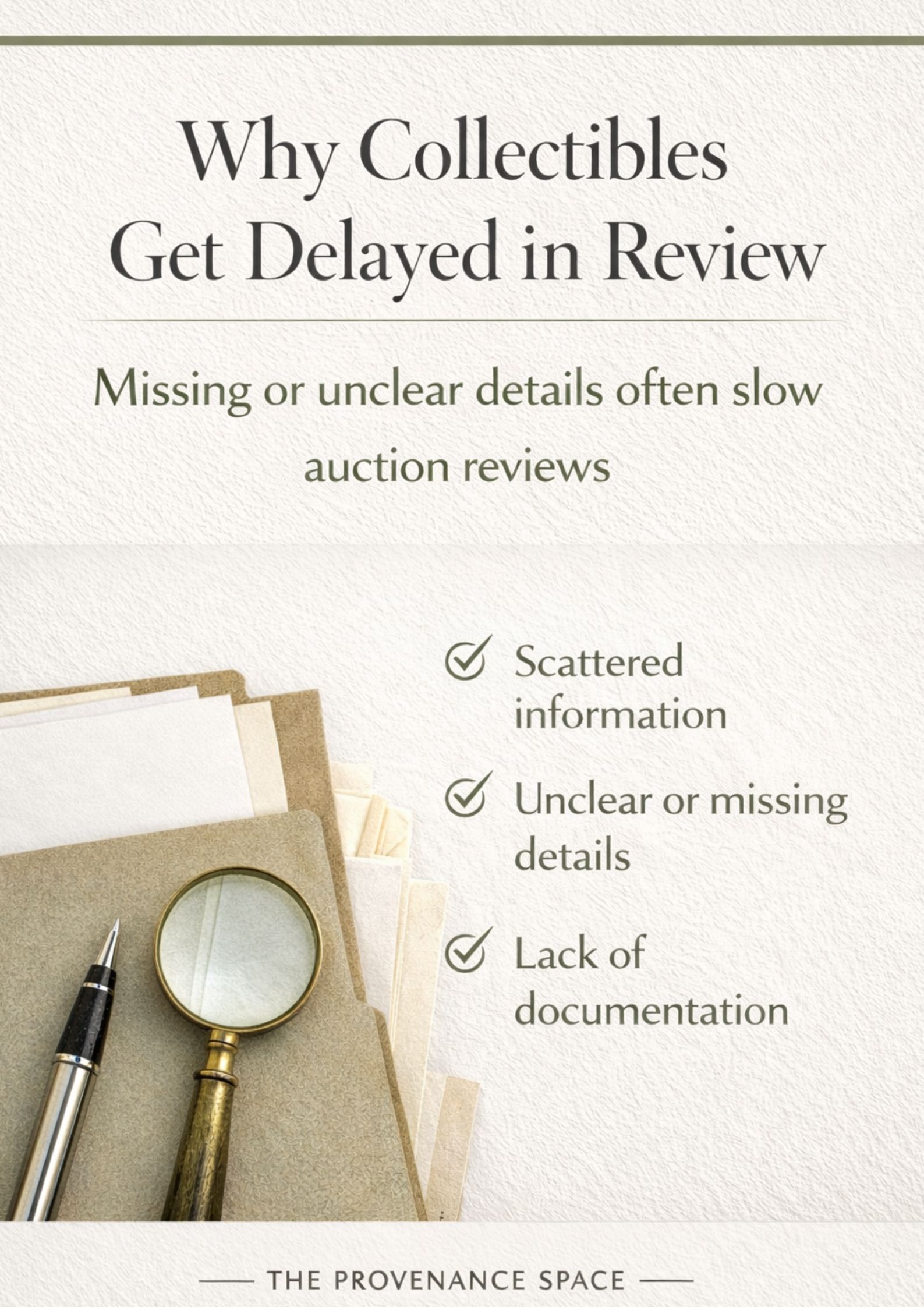
Why Collectibles Get Delayed in Review
Many sellers assume that when a collectible isn’t accepted quickly, it has been rejected. In reality, that’s rarely the case.
Auction houses and private buyers often do not decline items outright. Instead, reviews are delayed when key details are missing, unclear, or difficult to assess. These delays can stretch from days into weeks, leaving sellers frustrated and uncertain about next steps.
Understanding why reviews get delayed — and how to prevent it — puts sellers in a much stronger position from the outset.
Reviews Are About Risk, Not Just Value
When buyers or auction specialists review an item, they are managing risk as much as evaluating value.
They are asking questions such as:
- Do we understand what this item is?
- Is its history clear enough to stand behind?
- Are there condition issues that could affect pricing or liability?
- Is the information reliable and consistent?
If answers to these questions aren’t immediately clear, the review slows down.
1. Information Is Scattered or Incomplete
One of the most common causes of delay is fragmented information.
Details arrive across:
- Multiple emails
- Verbal explanations
- Partial notes
- Unlabeled photos
This forces reviewers to piece things together, which takes time and increases uncertainty.
Using a structured format — like the templates in the Sell-Ready Documentation Kit — helps present all key details in one place, making reviews more efficient.
2. Provenance Is Unclear or Vague
Provenance doesn’t need to be perfect, but it does need to be clearly explained.
Delays occur when:
- Ownership history is implied but not stated
- Dates are missing or inconsistent
- Assumptions are presented as facts
A concise provenance summary that separates what is known, believed, and unknown allows reviewers to assess credibility quickly. This is why the Sell-Ready Documentation Kit includes a dedicated Sell-Ready Provenance Summary template.
3. Condition Details Are Missing or Oversimplified
Condition plays a major role in buyer confidence.
Reviews slow down when:
- Condition is described too broadly (“good condition”)
- Known issues are not disclosed
- Restoration or repairs are unclear
A structured condition overview — like the Condition Report Template in the Sell-Ready Documentation Kit — helps sellers disclose issues clearly without over- or under-stating them.
4. Ownership History Isn’t Clearly Tracked
Even partial ownership history helps reviewers understand an item’s journey.
Delays happen when:
- Ownership information is buried in text
- Gaps are not acknowledged
- Chronology is unclear
Presenting ownership history in a simple, chronological log makes it easier for buyers and auction houses to follow the chain of custody. This is why many sellers use an Ownership History Log when preparing items for review.
5. Supporting Materials Aren’t Referenced Clearly
Receipts, labels, photos, or certificates can support an item’s review — but only if reviewers know what exists.
Reviews slow down when:
- Supporting documents are mentioned but not listed
- Files are sent without context
- It’s unclear what is available versus what is missing
A Digital Documentation Index, such as the one included in the Sell-Ready Documentation Kit, helps sellers reference supporting materials clearly without overwhelming reviewers.
6. Sellers Wait Too Long to Organize Documentation
Many sellers only begin organizing documentation after reaching out to buyers or auction houses.
This often leads to:
- Repeated follow-up questions
- Requests for clarification
- Extended review timelines
Preparing documentation before outreach allows reviewers to assess items more confidently from the start.
Why Clear Documentation Speeds Things Up
When documentation is clear and well-organized:
- Reviewers spend less time clarifying basics
- Confidence increases
- Decisions are made more efficiently
This doesn’t guarantee acceptance or sale, but it removes unnecessary friction from the process.
A Practical Way to Avoid Review Delays
Using structured documentation tools helps sellers:
- Present information consistently
- Avoid omissions
- Reuse documentation for multiple submissions
- Maintain control over how their item is represented
The Sell-Ready Documentation Kit was created to support this exact need — helping sellers prepare their items in a clear, professional format before review.
Final Thoughts
Delayed reviews are rarely about rejection.
They’re usually about uncertainty.
When key details are missing, unclear, or scattered, reviewers pause. When information is organized, transparent, and easy to follow, items move forward more smoothly.
If you’re preparing to sell a collectible, clear documentation won’t guarantee a sale — but it will remove many of the reasons reviews get delayed in the first place.
If you’d like a structured way to prepare documentation before reaching out to buyers or auction houses, explore the Sell-Ready Documentation Kit or start with a brief Seller Intake overview to determine next steps.